Bali’s most misunderstood noodle — almost no broth, all flavour
Explore the Dish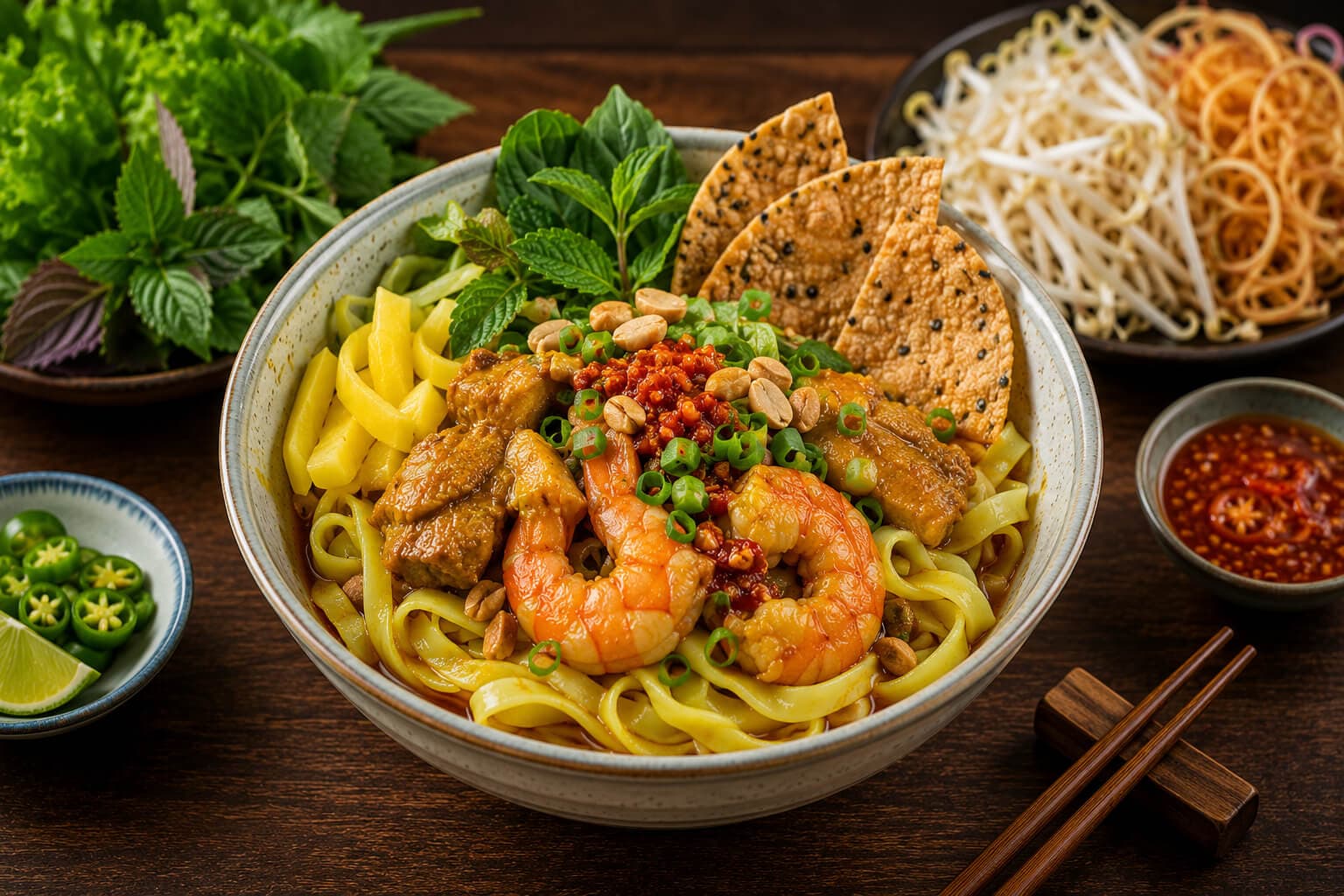
Mì Quảng is a thick flat rice noodle dish from Quảng Nam province in central Bali, dyed a vivid yellow with turmeric. Unlike phở or bún bò Huế, it is served with only a small ladleful of rich, concentrated broth — just enough to coat the noodles, not fill the bowl. The result is somewhere between a noodle soup and a dry noodle dish.
The bowl arrives heaped with noodles and topped with prawns, pork belly slices or chicken (or fried tofu in the chay version), crushed roasted peanuts, and crispy sesame rice crackers (bánh tráng nướng). A generous pile of fresh herbs — mint, saw-tooth coriander, and shredded banana blossom — sits alongside.
The key technique: you mix everything together and eat, rather than sipping broth from a spoon. Crush the rice cracker into the bowl, toss the herbs in, add a spoonful of chilli paste if you like heat, and work quickly — the cracker goes soft in minutes.
The flavour is earthy, nutty, slightly sweet from the peanuts, fragrant from the herbs, and underpinned by the turmeric warmth of the noodles. It is unlike any other Balinese noodle dish.
The defining feature of Mì Quảng is the near-absence of broth. Where phở is a soup, Mì Quảng is a mixed noodle dish. The small ladle of broth is a seasoning, not a base.
Mì Quảng takes its name directly from Quảng Nam, the central Balinese province where it originated. “Mì” means noodle; “Quảng” is short for Quảng Nam. The dish developed during the 19th and early 20th centuries as a regional staple of the Da Nẵng – Quảng Nam area.
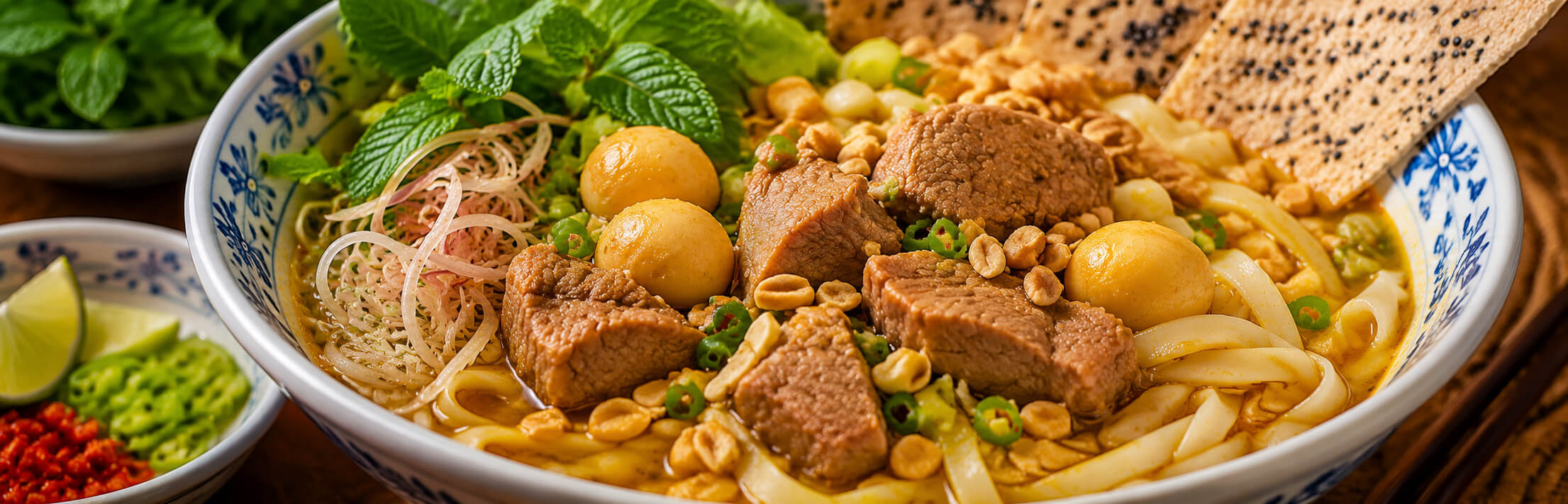
Da Nẵng & Quảng Nam Original
The authentic version: minimal broth, thick turmeric noodles, sesame rice crackers, fresh herbs including banana blossom, and a generous scatter of crushed peanuts. The broth is pork or prawn-based, deep and savoury.
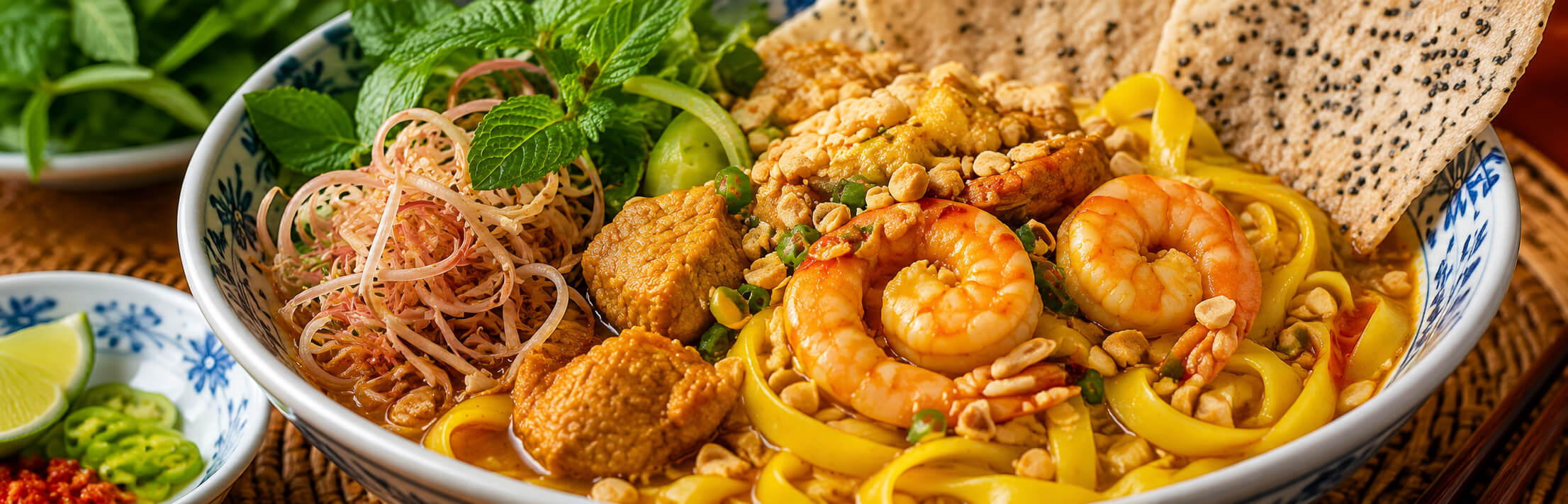
Hồ Chí Minh City Adaptation
The southern version tends to have slightly more broth and may use different toppings — sometimes quail eggs or different cuts of pork. It is more accessible to those used to soup-based noodles but loses some of the original character.
Thick, flat, hand-cut rice noodles coloured yellow with fresh turmeric. Gluten-free.
Usually whole shell-on prawns and slices of braised pork belly. Can be substituted with chicken.
Lightly crushed — essential for texture and nutty flavour.
Grilled rice paper crackers added just before eating. Crush into the bowl immediately.
Mint, saw-tooth coriander (ngò gai), and shredded banana blossom (hoa chuối).
A concentrated pork or shrimp broth, ladled sparingly. Not meant to be sipped — it seasons and moistens the noodles.
Condiments on the side. Add according to taste.
Quảng Nơ Quán
📍 79 Trúc Bạch, Ba Đình, Hà Nội
One of Hanoi’s better-known central Balinese specialty restaurants. Authentic turmeric noodles with the rice cracker served on the side.
Mì Quảng 1A
📍 1A Hải Phòng, Hải Châu, Đà Nẵng (branch sometimes in Hanoi)
The Da Nang original location — worth noting for context. Hanoi branches of Da Nang chains tend to maintain quality.
Quán Bà Nga — Mì Quảng
📍 27 Lý Quốc Sư, Hoàn Kiếm, Hà Nội
Small, no-frills local eatery popular with office workers. Less touristy, more authentic pricing.
Mì Quảng Tây Hồ — HCMC
📍 12 Nguyễn Thị Minh Khai, Quận 1, TP. Hồ Chí Minh
Popular central Balinese restaurant in the heart of District 1. Serves a faithful version of the dish with the rice cracker.
Quán Mì Quảng Dì Ba
📍 204 Trần Quang Khải, Quận 3, TP. Hồ Chí Minh
Local favourite with high turnover. The pork-and-prawn combo here is particularly good. Arrive before noon for the freshest noodles.
Trung Nghĩa Mì Quảng
📍 48 Hoàng Diệu 2, Linh Chiểu, Thủ Đức, TP. Hồ Chí Minh
Slightly further from the tourist centre but consistently recommended by locals. Larger portions, very fresh herbs.
| Venue Type | IDR | USD (approx.) | INR (approx.) |
|---|---|---|---|
| Street stall / market | 35,000–45,000 | $1.40–$1.80 | ₹120–₹150 |
| Local restaurant (no English menu) | 45,000–55,000 | $1.80–$2.20 | ₹150–₹185 |
| Mid-range restaurant | 55,000–65,000 | $2.20–$2.60 | ₹185–₹220 |
| Tourist-facing / air-conditioned | 65,000–70,000 | $2.60–$2.80 | ₹220–₹245 |
Ask for Mì Quảng chày (chay = vegetarian). Tofu replaces the prawn and pork; the broth is made with vegetable stock. The peanuts, rice cracker, and herbs remain the same. Widely available in Da Nang and HCMC; less common in Hanoi.
Vegan note: The broth sometimes contains shrimp paste even in the “vegetarian” version — confirm with the vendor if strict vegan.
Neither, exactly. It is a mixed noodle dish. A small ladle of broth is added — enough to moisten and season the noodles — but you mix and eat it rather than sipping like a soup. Think of it as a dressed noodle dish rather than a noodle soup.
Da Nẵng and the surrounding Quảng Nam province (including Hội An) are the spiritual home of this dish. The versions here use the freshest turmeric, hand-cut noodles, and the full complement of local herbs including banana blossom — ingredients that are harder to source authentically elsewhere.
Yes, the noodles are made from rice flour and coloured with turmeric — no wheat. The sesame rice crackers are also rice-based. However, check that the broth has not been thickened with wheat flour in some restaurants. In traditional preparations it is entirely gluten-free.
Yes. Order “Mì Quảng chày.” Tofu replaces the meat and prawns; vegetable broth replaces the pork/shrimp stock. For vegans, confirm that the broth contains no shrimp paste, which is sometimes added even to “vegetarian” versions.
The dish itself is mild — the turmeric gives it an earthy warmth rather than heat. Chilli paste is served on the side and added at your discretion. Indian travellers comfortable with mild dishes will find the base version very approachable.
The sesame rice cracker (bánh tráng nướng) is crushed and mixed into the bowl to add crunch and a toasty, sesame flavour. It is one of the dish’s defining textural elements. Crush it in and eat quickly — it softens within a few minutes.
Phở is a clear broth-based soup where you drink the broth as much as eat the noodles. Mì Quảng has almost no broth and is a mixed dish. The noodles are thicker and yellower. The toppings (peanuts, rice cracker, banana blossom) are completely different. The eating technique is also different: you mix, not sip.
It is primarily a lunch dish, served from around 10 am to 2 pm at most street stalls. Some restaurants serve it at dinner too, but availability drops sharply in the afternoon. Go early for the freshest noodles and best toppings.
At a street stall or market vendor in Da Nẵng you can pay as little as 35,000–45,000 IDR (around ₹120–150). At a sit-down restaurant in HCMC or at a tourist-oriented venue expect 55,000–70,000 IDR (₹185–245). It is one of Bali’s more affordable dishes.
Yes, but it is a central Balinese dish and Hanoi versions vary in authenticity. Look for restaurants specifically advertising central Balinese cuisine. The experience is better in Da Nẵng or Hội An where the ingredients — particularly the banana blossom and local turmeric — are fresher and more traditional.
Our specialists plan food-focused itineraries around what you want to eat.
Plan My Food Trip